Wednesday, September 15, 2010

Outsmarted by a spaniel

Yes, it hurts to type those words, and I could probably have added "again" to the title.

Larsen wants to own the birds and bird wings he grabs, rather than retrieve them and turn them over to me.  He needs to get more used to birds, I figure.  Treat them like a fact of life.  Not be so possessive.  Share and share alike.

On our morning walk, I let him carry Susan's firehose & birdwing getup.  Let's just walk together, old buddy, and you can carry the bird!  He trotted along with that in his mouth for a long while, looking pretty good if I do say so myself.  I am a dog training genius.

Then he set it down, and while I was fooling with my coffee, the leash, and being half asleep anyway, he gave that fetch toy a quick mark.  Even though I rinsed it in a handy lawn sprinkler, he knew it was his, and he more or less lost interest in it.  He basically said, hey, you carry that thing now, and I did for most of the walk until the end when it started drying out and he got re-interested.

Ok, two can play at this game.  I'm going to get a quail out of the freezer and let you carry that around for a while.  Just try marking that, buster.  I'll be ready.
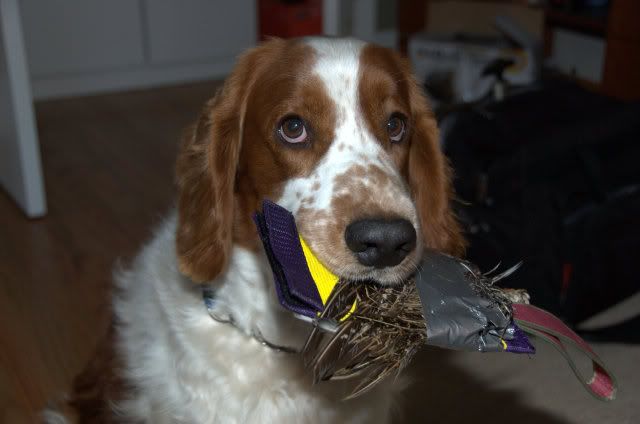
 
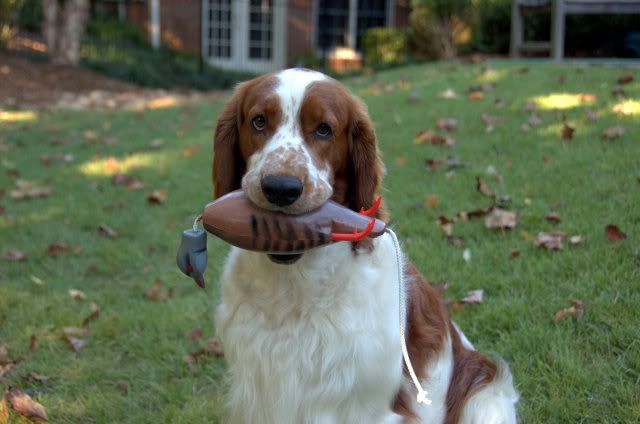
Larsen displays his chukar-winged firehose.

Tuesday, September 14, 2010

Dial it down, boy

Here's a way to get more energy out of a recalcitrant dog: wave a bird wing under his nose.

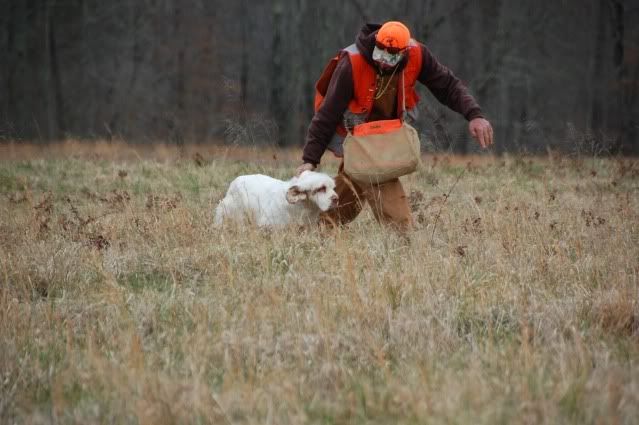
A week or so ago, Susan W. slipped me a piece of fire hose with a pair of wings duct-taped on.  Yesterday evening, I pulled that setup out and figured on a 6 foot toss & retrieve.  Larsen was excited about the retrieve, to be sure, but he also slipped into his old keep-away habit.  Instead of a retrieve, he took off and ran around, settled down to pluck  the feathers, and overall guaranteed himself a JH flunk-out.   

That sure didn't work, so we left the relative freedom of the back yard and went to the screened porch. I hupped him.  I told him to take the wings.  Sure!  Why not?  He took the wings, hupped and held.  But, you could see the wheels turning as he tried to calculate if he could make a successful break to the freedom of the back yard.

Every time he even looked toward freedom, I ahemed him back to attention.  Finally, I would tell him to "drop it" (his release command).  Ever so slowly -- you could see the yin and yang working in the old noodle --  his jaws eased back and he gave me the wings.

We did this a bunch of times.

They say that you should keep things interesting and stop before you bore the dog, but I think Larsen could have done that wing tease all night long.  He wanted to keep playing as long as he got those feathers in his mouth.  

Monday, September 13, 2010

Let's see a little energy

I put Larsen on the training table and told him to take the Dokken chukar.  He basically looked around and past the bird, and if he could have whistled an absent-minded tune, he would've done that. 

In contrast, Larsen was perfect with his other fetch toys.  He took hold of the barbell, wooden rod, or PVC pipe when told to and held each one until I asked for it.

So you see, there is something he sees in the bird that bugs him.  When I put the Dokken into his mouth, he holds it like a trooper - - but with no interest, excitement or anticipation of a treat or a pat. 

We stepped back.  Let's just fool with it.  He got a treat or two right off the Dokken, and then finally, for whatever reason, he gave the fetch dummy a grab by the body like he should.  Good deal.  Perfect.  Enough of that.

Later this morning, we played in the upstairs hallway with a few dummies, and I saw him going backward in the sense of playing with things instead of smartly picking them up and bringing them to me.

I got him excited for the Dokken - - waved it in front of him, bopped him with it, etc.  I went away from him.  He had to come toward me if he wanted to get the dummy.  I wouldn't let him have it unless he grabbed it the right way. 

That didn't happen often.  Once, or possibly twice.  But he did it.  Praise, treat, end of session. 

Sunday, September 12, 2010

The Dokken dead chukar is not just another retrieve dummy

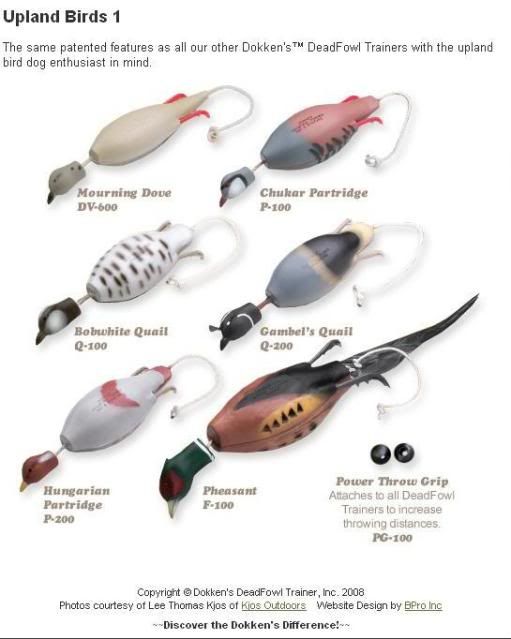
A dog trainer named Tom Dokken developed a retrieve dummy made of a firm foam that is shaped somewhat like a dead bird.  In fact, he has a score of these retrieve dummies in the shape of ducks, geese, and upland birds.


A sample of Dokken's dead fowl collection.


I recently got a chukar and a quail and thought I'd move Larsen from retrieving various play objects to retrieving these foam birds.  Big deal, right?

I did our first little drill, which is a six-foot toss & retrieve.  Larsen pounced on the foam bird and then proceeded to fool with it.  This is something he does not do with ropes, dummies, or other playful retrieve objects.

Somehow, he recognized the Dokken dummy as a "bird" and he started goofing off with it. I separated dog and bird and hupped him a few times.   Then I put the bird in his mouth the right way (I didn't let him dangle and swing it by the trailing string, or grab it by the head) and made him hold.  I stepped away from him and called him and hupped him.

We did that simple exercise a bunch of times.  He didn't seem to mind it, although I could tell he didn't like to have the bird stuffed into his mouth.  When I told him to "take it", he would pick at the head or tail ends and not just grab it by the body.  I could also tell that if I were to do the six-foot toss, we would go right back to simply goofing with it.

We're going to stick with the square one (hold and here boy) exercise for a bit.  I'll get him on the table with it beginning in the morning, as well.  I sure hope I can get him to advance before next Sunday's practice session!


Larsen hups and holds the Dokken chukar.

Wednesday, September 8, 2010

A retrieve exercise

My Labor Day outing with Susan and Allen showed me that Larsen's retrieving was below par, but that his obedience exceeded my expectations.  As a result, my 5 minute exercises with him have changed a little.  The focus now is on short little retrieves.  Here's the new exercise.

  1. Hup him.
  2. Toss one or two objects about 6 feet away.
  3. Tell him to get one of them.  
  4. When he grabs it, let him bring them in.  If he dawdles even a second, give him a triple tweet and some pats on my thigh to tell him to come in. 
  5. Make him hold & hup.  
  6. If everything is a success (and he doesn't spit it out), praise him, but don't give him a treat.  (If you tossed two objects, tell him to get the second one.)
  7. After all of the fetching and hupping is done, step a few feet away.   Call him and hup him.
  8. Do this again.  Then give him praise and maybe a treat.
I give praise but no treats for steps 1-6.  He may get the treat for coming and hupping from 6 feet away, which is something he already has in the bag.  (He is such a genius.) 

We're doing this new exercise with different objects. 


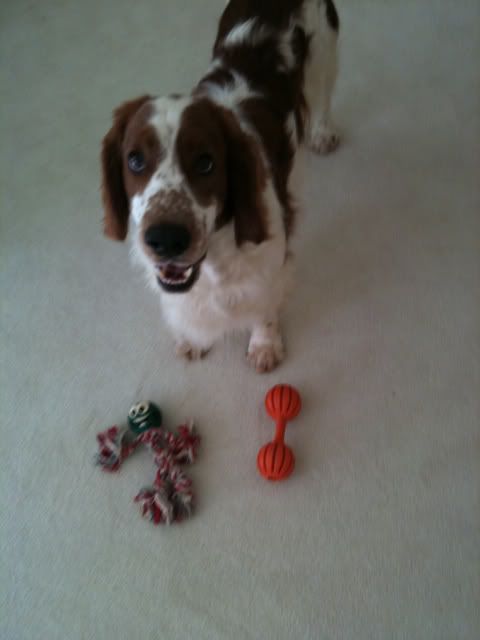
Larsen inspects the barbell and rope man fetch toys.


The barbell and rope-man have different feels.  The barbell is rubbery and rope-man is ropey.  I have in inventory a hard dumbbell, a piece of wood, and a piece of PVC pipe and a quail wing taped around a piece of firehose, which will get deployed at some point. 

As he progresses, I'll ask him to fetch it up from greater distances and with distractions.

At some point, when he's having success with everything else, he'll get a dead quail that currently is in the freezer.

Tuesday, September 7, 2010

The brainiacs are at it again

The ivory tower provides yet one more reason to train your dog in multiple locations. 

Despite our different training venues, Larsen does not associate the Treaty of Versailles with much of anything. 

"The brain makes subtle associations between what it is studying and the background sensations it has at the time, the authors say, regardless of whether those perceptions are conscious. It colors the terms of the Versailles Treaty with the wasted fluorescent glow of the dorm study room, say; or the elements of the Marshall Plan with the jade-curtain shade of the willow tree in the backyard. Forcing the brain to make multiple associations with the same material may, in effect, give that information more neural scaffolding.


“What we think is happening here is that, when the outside context is varied, the information is enriched, and this slows down forgetting,” said Dr. Bjork, the senior author of the two-room experiment.


Varying the type of material studied in a single sitting — alternating, for example, among vocabulary, reading and speaking in a new language — seems to leave a deeper impression on the brain than does concentrating on just one skill at a time. Musicians have known this for years, and their practice sessions often include a mix of scales, musical pieces and rhythmic work. Many athletes, too, routinely mix their workouts with strength, speed and skill drills."

Benedict Cary, "Forget What You Know About Good Study Habits," New York Times, Published: September 6, 2010.

Monday, September 6, 2010

Rally novice title

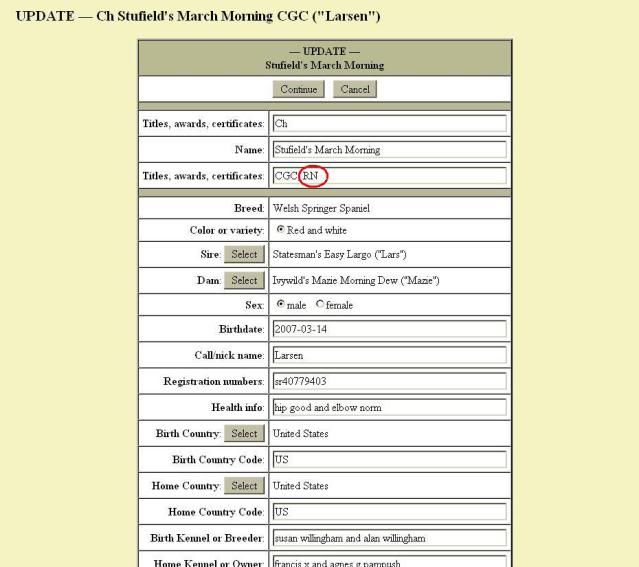
Larsen earned three legs and his Rally Novice title in the Cherokee Rose Cluster on August 27-29.  I was able to update his profile on the Pedigree Engine.  He did a nice job that weekend. 

Sunday, September 5, 2010

Dummy practice

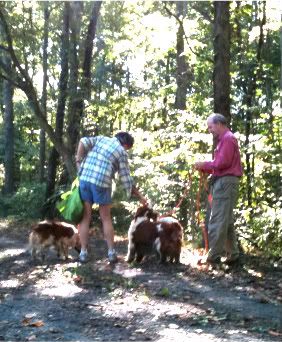
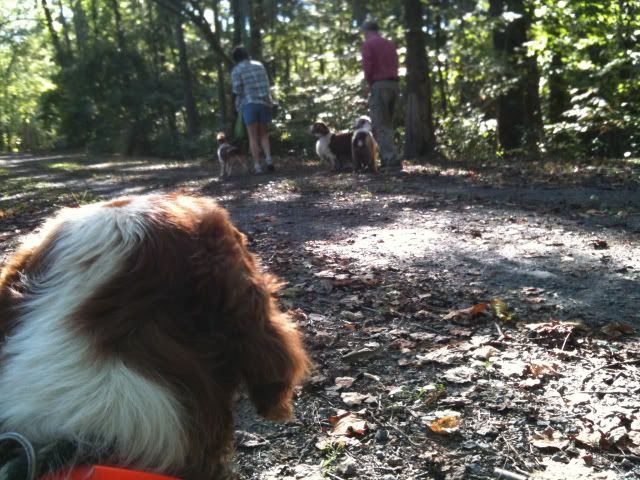
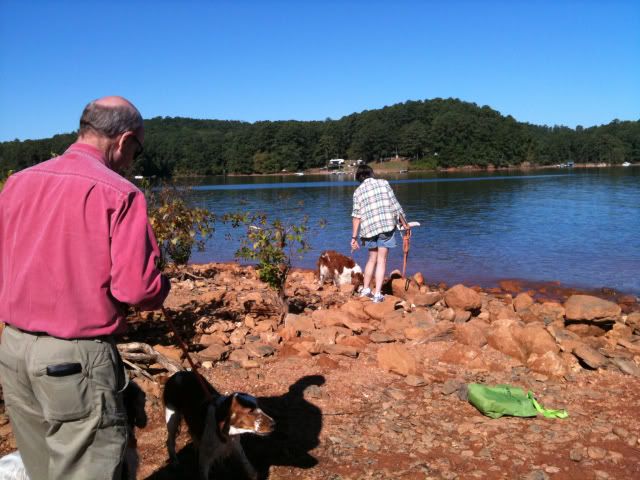
I caught up with Susan and Allen W. to give our dogs a little bumper work at Lake Allatoona this morning.  I brought Larsen. Susan and Allen brought Lars and Mazie, Larsen's sire & dam, and Tatum.  We did some bumper retrieves on land and water.

Larsen's retrieving was nothing to write home about.  Certainly not where he needs to be for October, but there were some solid things to build on:

  • Larsen minded my commands, including commands to come, even when he was otherwise preoccupied with the lithesome Tatum.
  • Larsen would return to me, hup, and then head back out when I resent him for a bumper (albeit one he had failed to return).
  • When Larsen didn't feel like picking up the bumper, he made moaning and groaning sounds, but did it anyway.
This is hardly JH stuff, but now I see that we should change our practice time allocation from one of pure obedience to one of fetches of different things, including cloth bumpers and then wings.  (To this point, I've had him fetch a large piece of cotton rope and some rubber bumpers.)  That's progress!

I'll also make sure I get him on the table every day to pick something up and hold it.  We'll repeat retrieves, pick-ups, and holds every day for the next few weeks.   

Tatum set a great example for both land and water.  She's a very eager little dog who clearly enjoys any type of field work.  Mazie is simply fun to watch.  She's very accomplished and responds to the whistle with a beautiful nonchalance - - as though she herself independently had determined to do the very thing that the whistle asked of her.

It was a nice time and, like any group training no matter how small, renews your enthusiasm for the work.


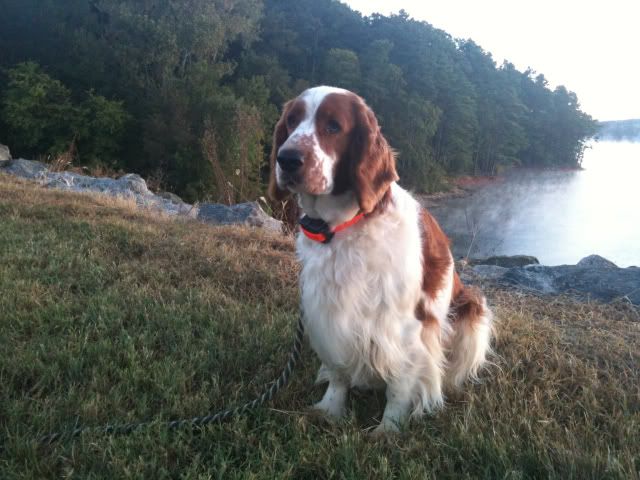
Larsen hups along the berm of Lake Allatoona.


Susan and Allen prepare the dogs for some retrieve work.


Larsen waits.  

Dogs can be circumspect and even obstinate when asked to retrieve, but are always indescribably eager when asked to wait their turns.


Mazie completes a water retrieve while Allen and Tatum observe.

Friday, September 3, 2010

Castaway

I sent my 20 gauge to Beretta to get it restocked to fit a left-handed shooter.  I got it back today and will try it out on Saturday morning.


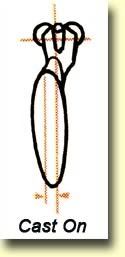
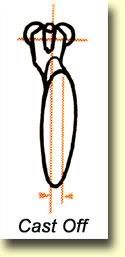
Most gun stocks are straight, but on better guns the stocks are subtly bent in one direction or the other. This is called cast. The bend is about 1/8 of an inch or maybe 1/4 inch, so we are not talking about a banana. You might not really even notice it if you glanced at it. (These sketches are courtesy of Bill Hanus's website.)  Left handed shooters may use "cast on" while right-handed shooters would use "cast off".  


   What the bend, or cast, is intended to do is allow a more natural alignment of the shooter's dominant eye along the ridge of the gun.  You don't sight a shotgun as you do a rifle.  Instead you look along straight along the line of the barrels, without looking at the barrels, at the object you would like to hit.  Just as you don't look at the bat in baseball or the racket in tennis, you look at the object you want to hit.  When you have a consistent and accurate alignment of the eye, the barrel, and the lead hand, you have a better chance of hitting the bird or the clay.  


When cast is absent (or goes the wrong way) you might cant or twist the barrels of an over-under gun.  This aligns the top barrel with your eye, but the bottom barrel is out of the vertical plane and presto, your first shot (usually from that bottom barrel) is off.

I don't want to oversell what cast will do for me or anyone else.  One of the better shooters that I know is totally indifferent to cast.  He is left handed, but shoots the guns right off the rack.  He said that at one time he went through the whole ritual of making minuscule adjustments, but nowadays he just shoots.

Of course, his is similar to the story that Lee Trevino would win bets by using a taped-up Coke bottle on the end of a chain to out-drive other golfers.  It can be done, but not by me.  

Wednesday, September 1, 2010

Shut out of regionals

I had thought that if Larsen got a leg on Rally he would be eligible for something having to do with a hunting test invitational on Saturday in October at the regional Welsh Springer Spaniel show in Perry, Ga.  I was mistaken.  He's eligible for something having to do with Rally.

That's great.  I may concentrate on preparing for the following Monday's open hunting test at the regionals.  We'll see.

Our preparation will involve working on the retrieve.

Time to get back to the bench and to the field with dowels and dummies.  September is here, even the daytime 90s seem cooler, and it's time to buckle down. 

Monday, August 30, 2010

Scenes from the weekend


This must be the place.


Meghen prepares one of her charges.

Showtime.


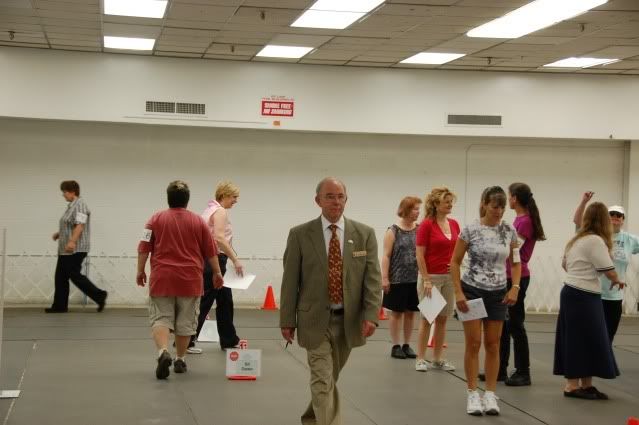
Over at Rally, contestants step off the course.

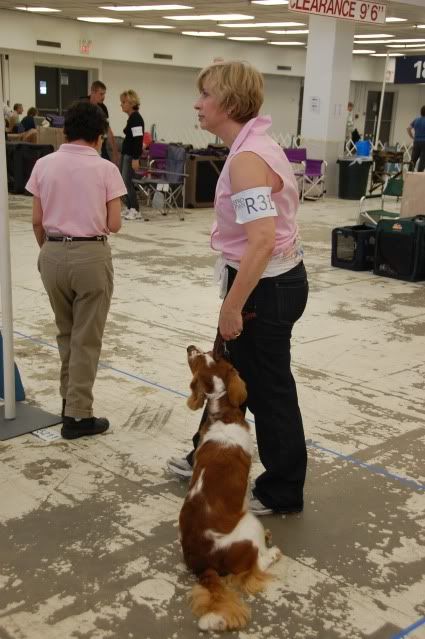
MaryAnne and Chance wait patiently.


It's our turn!


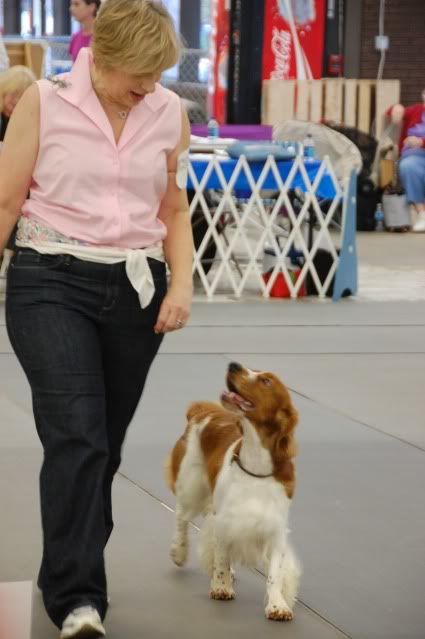
Chance scores a passing grade and earns an advanced Rally leg.

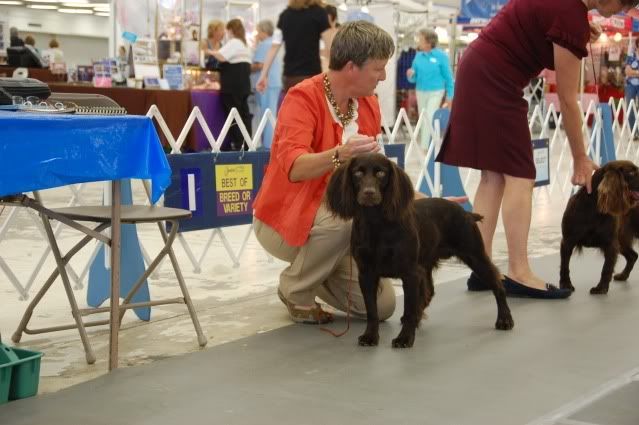
Kim enjoys a lighter moment in the Boykin ring.


Back to business.


A fun, but long weekend.

Sunday, August 29, 2010

Surprising finish

Larsen placed 3rd in Rally Novice A to earn his third leg and his RN title.

I had to grab my reading glasses to be sure that the score, 83, was a qualifier, and not a 63, a non-qualifier. 

Larsen did pretty well along the whole course until the figure 8 near the end.  At that point, he became interested in something far away.  I rolled a hand grenade into the middle of his head by asking "is that Aki"?  Larsen came right back from wherever he was and looked around with great interest to see if he could locate Aki.  Of course, he could not, but it got his attention back to me, we completed the figure 8, and went about our merry way on the course.

It wasn't just Larsen with his head in the clouds. The judge took a minute to explain to me several missteps that I had made that brought Larsen's score down.  Sorry Larsen!

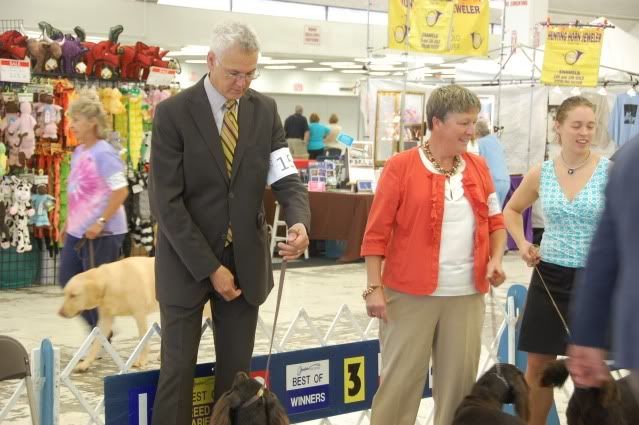
Due to the timing of the Rally competition, I missed the WSS conformation.  I caught the Boykins, though.  Here is Susan W. in the ring with Ritz.


Susan fusses over Ritz in the conformation competition.

Gentleman's C

Larsen earned his second Rally Novice A leg on Saturday, scoring a gentleman's C of 74 (a 70 is required to qualify). 

In my opinion, he did fine until we got to the far end of the room, near the gallery.  Larsen broke away a few steps, put his nose over the fence and started air scenting.  What he was after, I haven't the faintest idea.   It wasn't fried chicken or other food, he's smelled that before.  Sue R. thought it may have been a bitch in heat.  Another contested later said that someone popped open one of the doors to the arena and he may have been smelling the outdoor air that wafted in.  Whatever it was, it left me flat-footed and unprepared and made him seem like a disobedient dog.

We finally got back on track, finished a very tricky course, and earned the green qualifying ribbon. 

We are heading back today, Sunday, for our try at the third and final leg.


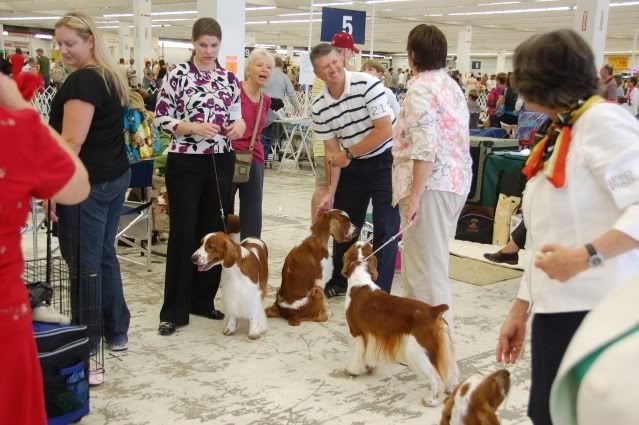
The Dogwood WSS club members prepare their dogs for the ring.

Friday, August 27, 2010

Got a leg

Larsen finished in 4th place in Rally Novice this morning to earn his first leg (of 3) toward a Rally Novice title.  He might have finished higher but for operator error.  It turns out I let the leash drag, which looks sloppy (according to the judge) and so nicks you a point.

Larsen was his usual happy self, and of course beside himself when he saw Susan W.  But when he went into the ring his head and tail droopped, which the judge pointed out to me.  Was he nervous?  But once we got going, both of us forgot all about it.  He basically stuck next to me when I told him to heel and sat near me when I told him to sit.  That is all there really is to Rally Novice.

MaryAnne and Chance earned another leg in their quest for the more advanced Rally Excellent title.  Chance was totally distracted in the ring for some reason, but he did what MaryAnne asked and looked good doing it.  Little Chance has filled out and is a nice looking dog.


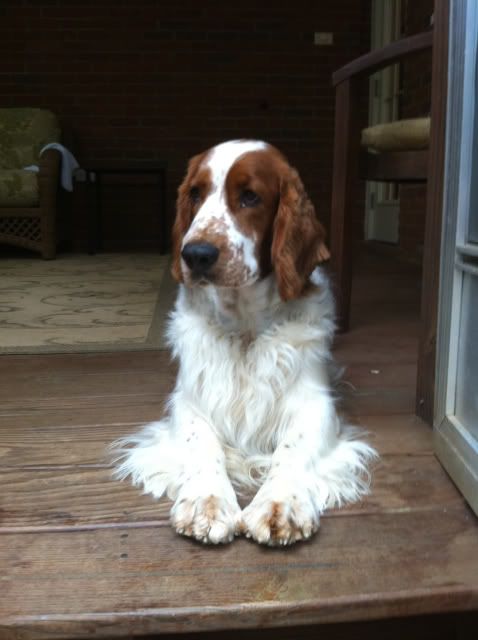
Larsen relaxes in the hallway after returning home from his Rally outing.


Chance earns another leg toward his Rally Excellent title.

Thursday, August 26, 2010

Rally-O this weekend

Tomorrow and this weekend Larsen and I will participate in Rally Novice A.

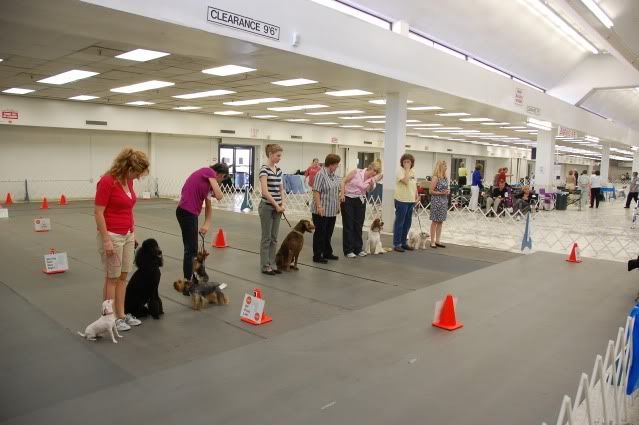
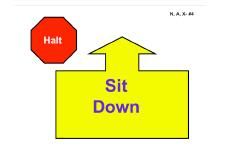
Rally is a watered-down version of Obedience. In Rally, dog & handler complete an enclosed obstacle course.  (In the Atlanta show, the course is indoors and marked off by a low gate.)  The obstacles are traffic cones with road signs that tell you and the dog to do something.

In the sign below, the handler and dog are asked to (1) come to a halt; (2) hup or sit; (3) go into a down position; and then (4) get up, come to heal heel and proceed to the next station.


I have a sneaking suspicion that the Novice A level will have lots of wiggly little puppies, but, what the heck, that is where we belong, really.  We are doing our best and will go for a passing score.

Larsen knows how to zig-zag around the pylons.  He knows how to hup and heal heel.  He's not that great on the "stand" command because we haven't practiced it much.  So it will boil down to whether he gets distracted and whether there are some difficult requests - -  asking him to play the piano, for example - - in the field.

Wednesday, August 25, 2010

It's still hot out there

A dog can succumb to heat exhaustion and move on to heat stroke very quickly.  Heat stroke leading to death can happen even to the mature, healthy dog of a caring and experienced owner. 

The dog has no efficient way to get rid of heat, and there is an inflection point in the dog's internal temperature after which things go wrong fast.  One minute the dog seems fine, and the next he is in dire circumstances.   

A dog's normal internal temperature is 100.5 to 102.5.  Above 103 F is a problem (source: about.com, citing to Merck Veterinary Manual, 9th ed.)

The internet provides all sorts of checklists to identify heat exhaustion and heat stroke, but the incipient symptoms are pretty obvious - - the dog returns from a run on a hot day panting like a MARTA bus pulling away from the curb, frothing at the mouth, and a tongue hanging to one side.

Pull that dog from the field for a moment and get him settled down.  Give him some water, or get him into some water to cool down.  Most lake water in Georgia is > 80 F right now, which is very warm, but still 20 degrees cooler than the dog's internal temperature.  Just sit for a while.  Get everyone back and centered.

If you've ever played a sport on a hot day, you may know how heat can sneak up on you and you don't realize it until you've been on the sidelines drinking water for a while, your ears pop, and suddenly the world, which seemed fine, comes into focus.  He doesn't know it either, and you have to watch out for him.

Pre-season training with an eager dog provides an opportunity for harm.  Watch for that tongue drooping to one side.  It's the first sign.  Get his tongue to hang from the center of his mouth before you go again.  Don't forget about the rule of 140.

Monday, August 23, 2010

Day's end

Friday rush hour.  We fought traffic up I-75 and past I-575.  We finally broke free and reached the Civil War fields around Lake Allatoona.  

We hiked the shoreline and explored the woodland pathways.   Clouds of bugs settled over the lake, where the fish snapped them up.  Deer moved in the gloom.  Larsen melted into the woods for minutes at a time.  He returned frothing from his runs, his sides working like a bellows.  I sat him in the water until he finally cooled.  The heavy evening air can be too hot for a hard-running dog.

We headed home in the near-dark evening.  We drove through a heavy rain that finally broke.  We got home, and got Larsen watered, settled, and fed.

Then Larsen and I sat on the back porch and watched it get dark.


Larsen enjoys the day's end.

Wednesday, August 18, 2010

Patience and repetition

Some good points from trainer John McGonigle in the autumn 2010 edition of Upland Almanac (John McGonigle, "Replacing Cruelty with Patience and Repetition," The Upland Almanac, Autumn 2010, p. 37 (not available online yet)).
 Few joys in life compare to watching a good hunting dog hunt with joy and abandon, search hard for birds and retrieve downed birds with his head held high with pride.

That's what we are after.  Here are some of McGonigle's thoughts.
  • Training hunting dogs is a time consuming activity that takes a lot of patience, repetition, and consistency. [ed: but it can still be a good time, right?]
  • Keep one's voice at normal volume.
  • Train a young dog in a closed area or smallish fenced yard.  There's a reason it is called "yard-training," and the reason is that it is effective.
  • When pup fails to respond immediately, it is best if the trainer hurries over to the pup and makes him comply with the command immediately.  Often that means picking pup up and bringing him back to the site of the infraction or returning him by pulling pup with his lead.
  • Roughness is unneeded at this time.
  • [When pup is a little older] grab pup by the loose skin at both sides of his neck, picking him up and returning him to the site of his indiscretion.  Once pup has a good idea [of what he did wrong] giving him a bit of a shaking while he's off the ground can be helpful.
  • Do not hurt pup or treat him harshly.  [ed note: firm & fair.]
  • Patience, consistency, and repetition will win out over brutality every time. 


This clumber gets a little tough love from judge Joe.

Tuesday, August 17, 2010

Quote of the day for the rest of us

The pull quote in the Upland Almanac story is inane:
The real secret with training hunting dogs is to never let them disobey.
Well, that horse is out of the barn.  Is it time to give up?

The rest of the story provides the context for the pull quote and a lot of information:

The real secret with training hunting dogs is never let them disobey.  If the do, stop them in their tracks and return them to the site of their misdeed and make them repeat the task correctly.  Repetition, repetition and more repetition train hunting dogs.  That is, repetition of correct behavior.
That's helpful advice and a good quote of the day for every amateur trainer.

Larsen and I can do our backyard drills ("here boy", "hup", "heel", "stay", "down").  We actually have fun, we zig-zag around some orange cones periodically, fetch a few things, and earn a treat or two every now and then.  Over and over again.

The Upland Alamnac article (John McGonigle, "Replacing Cruelty with Patience and Repetition," The Upland Almanac, Autumn 2010, p. 37 (not available online yet)) provides some other pointers.
Here's one that would have been useful to me last July.   

You must be quick to crack down on his misdeeds. You will likely find yourself chasing pup down and returning him to the scene of his crime.


If you can comfortably do so, [pick] pup up by the sides of his neck [and march him to the scene of the crime]. If you cannot do so easily, pull him by his collar towards his infraction and spin him in a circle once or twice and then correct him right there. Spinning him disorients him slightly and allows your correction to sink in even without fully returning to where he was.
That is helpful advice for those meltdown situations where there is no way either one of you can even remember where the infraction first occurred let alone find your path back to it. 

Sunday, August 15, 2010

Backtrack Point 5

Last Saturday I left my compass-like Backtrack global positioning system on top of the car. It slid off while I was driving and another car ran it over.

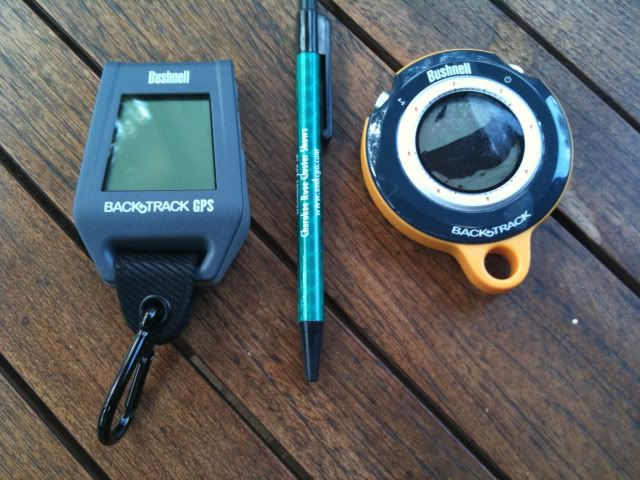
The Backtrack is a limited GPS.  It does not do much except indicate the direction and distance to your car.  That's not much until you realize you're lost and the sun seems lower than you think it should be.  (I reviewed the Backtrack here.)

There is a reason why my Backtrack was on top of the car in the first place.

The Backtrack takes a long time to find the satellite and give you any useful information. I put my Backtrack on top of the car while we sat and waited for the owner of a lost dog to stop by and pick him up. I wanted the Backtrack to have a clear view of the sky and the satellite.  Predictably, I forgot all about it when it came time to leave.

I bought another Backtrack, this one BackTrack 2 (it is really called Backtrack Point 5): the upgrade.

Forget about the fact that it can set 5 locations rather than the 3 of Backtrack 1. Who can remember 5 locations anyway? There are several things to like about Backtrack Point 5:

  • As advertised, Backtrack Point 5 finds the satellite faster.  Much faster.  Backtrack 1's long lead time needed to find itself was a real shortcoming with me.  If not for last Saturday's events, I would have lost Backtrack 1 eventually, leaving it somewhere else.
  • A digital clock that links to satellite time.  You really need a watch when you are out so that you know exactly when you left the car, how long you've been traveling, how much time you have before sunset, etc.  Since I often don't wear a watch when hiking, I find the digital clock is a good add.
  • Altimeter.  Maybe not critical, but another good add.  How high in the mountains are you anyway?  
  • 4 buttons instead of two.  It actually makes the operation a little easier for some reason.  Somehow with Backtrack 1, I would always press the wrong button and re-set the locator so that it found the exact spot where I was standing when I really wanted the direction to the point I was going.

You can get Backtrack 1 on Amazon for $44Backtrack Point 5 is $99.  That's a big difference.  Backtrack 1 is just fine.  I would not have looked twice at Backtrack Point 5 if someone hadn't run over my Backtrack 1.  But if you are looking, I will say that the digital clock, faster satellite lock-in time, altimeter, and 4-button operation represent genuine upgrades to a  nice gadget.

The Backtrack Point 5 is a break from the old-school compass style of Backtrack 1.